A Faith With a Deep Tradition Finally Gets a Digital Home Built to Match
The Ethiopian Orthodox Tewahedo Church is one of the oldest Christian institutions in the world, with a scriptural canon, liturgical calendar, and devotional literature that stretch back nearly two millennia. Yet for decades, much of that richness lived in printed books, handwritten manuscripts, and oral tradition passed down through generations—hardly accessible to a young diaspora member scrolling on a phone in Addis Ababa, London, or Toronto. Tewahedo One, developed by Ethiopian developer Abraham Sisay Getachew under the Kemekol label, is an attempt to close that gap. The app's own framing is telling: it wants to be a "sacred home" where the scattered pieces of daily spiritual life—scripture, prayer, teaching, and church history—come together in one place rather than being scattered across a dozen websites and PDFs. For an app that launched to modest attention (17 ratings as of its listing), the ambition is strikingly large.
The Full 81-Book Canon, Not an Abridged Version
The most significant feature—and the one that distinguishes Tewahedo One from generic Bible apps—is its inclusion of the complete 81-book Ethiopian Orthodox canon. The EOTC canon is broader than the Protestant 66-book Bible and even wider than the Catholic or Greek Orthodox canons, incorporating books such as Enoch, Jubilees, and the Meqabyan, which most other Christian traditions do not treat as scripture. For a devotional app to carry the full canon, rather than trimming it to the familiar core, signals that it was designed with the actual liturgical life of the Ethiopian church in mind. This is not a Western Bible app with an Ethiopian skin; it's built from the Ethiopian tradition outward, which matters enormously to its target audience.
Prayer and Liturgy, Carried in Your Pocket
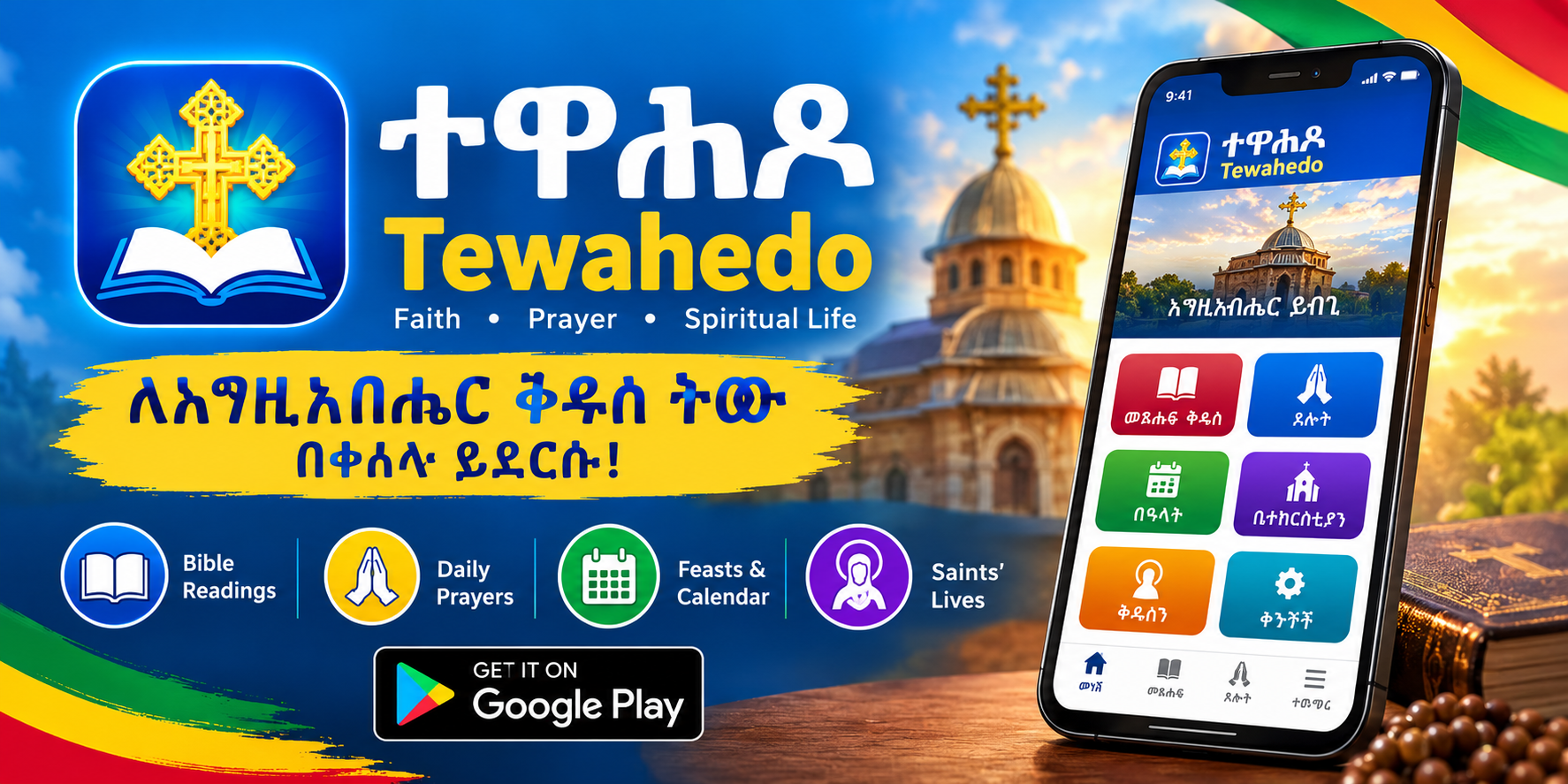
The app's prayer section reads like a portable prayer book, and it is unusually generous. It includes the Wudase Mariam (the Praise of Mary), Melka Yesus and Melka Mariam (the Communion of Jesus and of Mary), and daily Orthodox prayers available in Amharic, Ge'ez, and English. That trilingual approach is practical, not decorative: many younger EOTC members pray in Amharic but revere Ge'ez as the liturgical language, while diaspora families need English to keep children connected to the tradition. A recent update added "My Prayers," letting users save their own prayers and select specific psalms—a small feature that turns a static prayer book into a personal devotional tool.
At a glance, the core features include:
- The complete 81-book Orthodox Bible
- Daily prayers and liturgy in Amharic, Ge'ez, and English
- Synaxarium (Metsihafe Sinksar) aligned with the Ethiopian calendar
- Curated articles on church history, doctrine, and theology
- A Q&A section with "Tewahedo AI" for faith questions
Following the Church Calendar, Day by Day
The Synaxarium—the daily reading of saints' lives and martyrs' stories—is one of the most distinctive rhythms of Ethiopian Orthodox devotion, and Tewahedo One integrates it fully, synced to the Ethiopian calendar. That alignment is not a trivial technical detail. The Ethiopian church follows its own calendar with 13 months and its own cycle of feasts and fasts, and an app that gets this wrong would be useless for daily practice. Presenting saints' biographies and church history in step with the actual liturgical calendar means a user can open the app any morning and find the reading the church itself is observing that day. It is the kind of quiet correctness that separates a serious devotional tool from a devotional-themed app.
Tewahedo AI: Ambitious, Useful, and Worth a Little Caution
The headline feature—and the one most likely to draw both praise and scrutiny—is the Q&A assistant branded "Tewahedo AI," which promises answers to spiritual questions that are "biblically and canonically accurate." The appeal is obvious: a young person with a theological question at midnight may not have a priest on call, and a well-grounded AI can serve as a first stop for understanding a doctrine or a passage. The recent update expanded the theological library further, adding Church Fathers commentary (Chrysostom, Cyril, Clement) in English and Haymanote Abew, the traditional Ge'ez and Amharic exposition of the faith.
That said, any AI answering questions of doctrine deserves a caveat. Language models can sound authoritative while being subtly wrong, and the Ethiopian Orthodox tradition places real weight on the guidance of priests and the consensus of the church. The wisest way to use Tewahedo AI is as a study aid and a conversation starter—a tool that points you toward scripture and the Fathers, not a substitute for pastoral counsel. The app's framing ("guide," "answers to questions") is appropriately modest, but users should hold it to that standard.
A Thoughtful Reading Experience, and a Developers' Update Worth Noting
For a free religious app, the attention to interface is notable: light and dark modes, adjustable font sizes, and a navigation structure built for distraction-free reading. Anyone who has squinted at an Amharic or Ge'ez text on a phone screen knows why adjustable type matters—script fonts render very differently from Latin ones, and the app's settings acknowledge that. The "What's New" section also reveals an active development cycle: the most recent update added not just the Church Fathers commentary and Haymanote Abew, but new prayers, a daily Christian Life message on the home screen, corrected teachings, and speed and security fixes. An app that is still correcting its Q&A answers and patching security is one that its developer is actively tending—which is reassuring, though it also means the content is still maturing.
Privacy, Transparency, and the Practical Fine Print
The Play Store's data safety section is worth reading carefully. The developer declares that the app does not share data with third parties, that data is encrypted in transit, and that users can request deletion of their data. It does, however, state that the app may collect personal information and app activity—a disclosure broad enough to warrant attention. The developer contact is a personal Gmail address rather than a corporate one, which is common for indie apps but is a detail worth knowing if you have concerns about accountability or long-term support. There is no paid tier visible on the listing, so the app appears to be free—but free apps with AI features often have backend costs, and it's worth watching whether a subscription model appears later.
Practical considerations for prospective users:
- The app is free and has no obvious ads per the listing.
- Data collection is disclosed but limited; no third-party sharing is declared.
- Support comes from a single independent developer, so expect a smaller team's pace.
- The AI answers are a study aid—verify important doctrinal questions with a priest.
The Verdict: A Serious Devotional Tool With Room to Grow
Tewahedo One is the rare religious app that takes its tradition seriously rather than dressing up a generic template. The full 81-book canon, the trilingual prayers, the Ethiopian-calendar-synced Synaxarium, and the recent addition of patristic commentary all point to a developer who understands what EOTC practitioners actually need. The AI feature is the boldest bet, and its long-term value will depend on how carefully it is curated and corrected—the latest update suggests that work is underway. It won't replace your parish, your priest, or your printed prayer book, and it shouldn't try to. But as a daily companion that carries scripture, prayer, and church history in one pocket-sized home, it is a genuinely welcome addition to the Ethiopian Orthodox digital landscape—and one worth trying if you've been looking for exactly this.